
Our strategy · 7 min read
How we optimize technical content for qualified traffic
We start with buyer questions and company evidence. We improve weak content, create missing answers, connect related pages, and use search and business data to guide every revision.
We start with the decision behind the search
A keyword tells us that someone is looking for information.
It does not tell us everything that person needs.
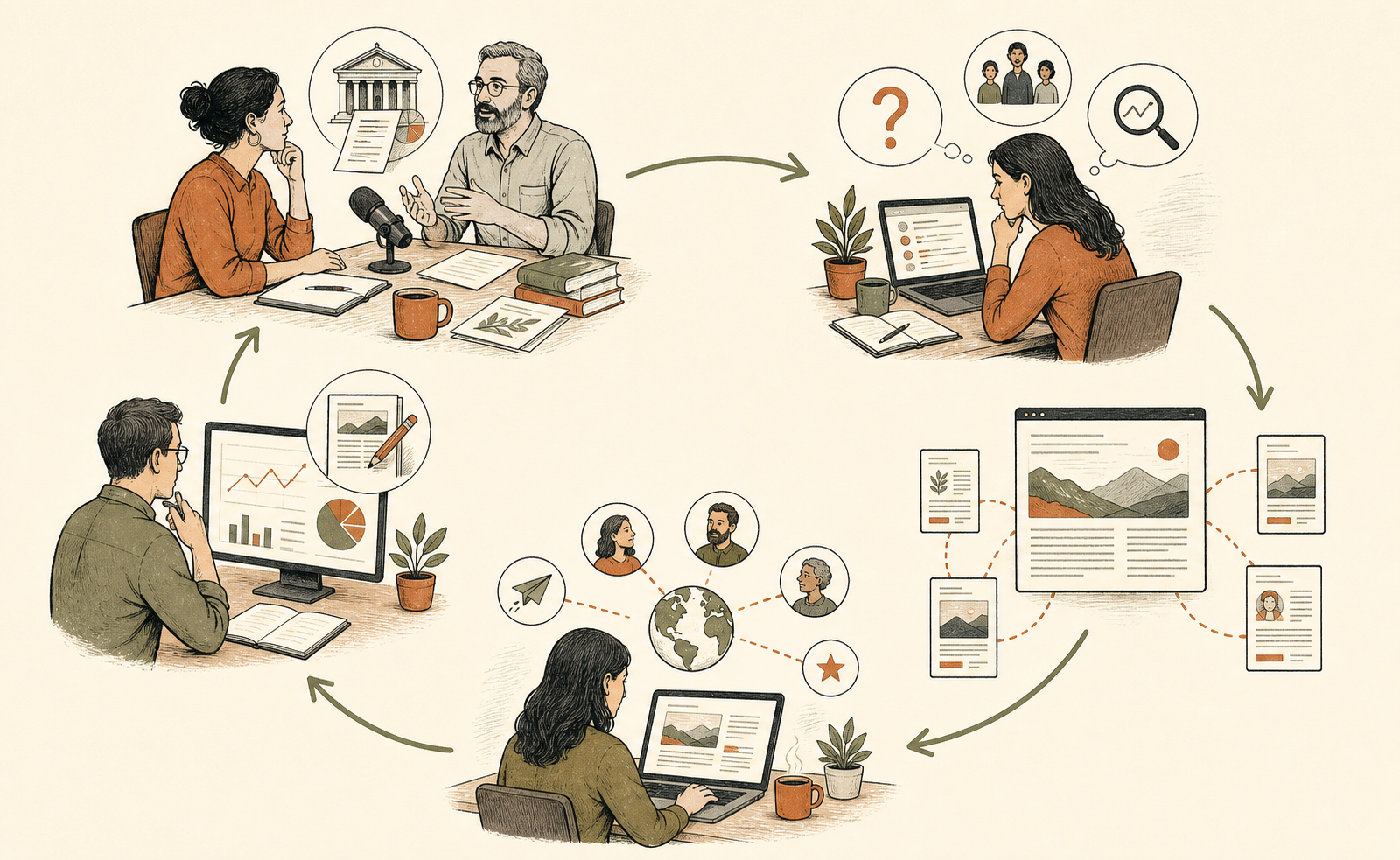
We turn company evidence into useful answers, then use observed results to guide the next improvement.
We begin by asking what the searcher is trying to understand, compare, solve, or decide.
Someone searching for integration cost may need an initial budget range. Another person may be comparing an API with a manual workflow. A third may be assessing implementation risks.
These searches may use similar language, but they represent different decisions.
Our strategy connects each decision to the right company expertise, content format, and next step.
1. We define the commercial boundary
Before planning content, we clarify what the company can genuinely prove and deliver.
We document:
- the services and products being offered;
- the customer problems the company solves;
- the industries and regions it serves;
- the technical constraints that affect delivery;
- the questions raised during sales and implementation;
- and the actions a qualified reader should take next.
This boundary prevents us from attracting traffic for subjects that have little connection to the business.
We do not try to make a company visible for every topic in its industry.
We focus on the problems where its knowledge, services, and customer needs overlap.
Traffic becomes valuable when the reader has a relevant problem that the company can actually solve.
2. We audit the expertise that already exists
We do not assume that every content project should begin with a blank page.
Technical companies often have valuable source material across:
- product documentation;
- Confluence or Notion pages;
- support tickets;
- technical reports;
- implementation notes;
- sales conversations;
- research documents;
- customer questions;
- and specialist knowledge.
We review these sources to identify expertise that could answer meaningful buyer questions.
For each source, we ask:
- What problem does this information help solve?
- Who would find it useful?
- Is the evidence specific and reliable?
- Does a public page already cover the subject?
- Can an external reader understand the current explanation?
- Is the information current enough to use?
This audit helps us identify three different situations.
Some useful answers have never been published. Some already exist but are difficult to discover. Others need stronger evidence, clearer structure, or better alignment with buyer intent.
We use these findings to build the real content backlog.
3. We connect buyer questions to company evidence
We plan each page around a real question and a credible source of evidence.
We collect questions from:
- sales conversations;
- customer support;
- product documentation;
- search data;
- implementation teams;
- customer interviews;
- and subject-matter specialists.
We then connect each question to the people, documents, examples, or data that can answer it properly.
For every planned page, we define:
- the primary buyer question;
- the intended reader;
- the decision the reader is trying to make;
- the evidence required to support the answer;
- relevant limits, conditions, and trade-offs;
- related pages that should be connected;
- and the most useful next action.
Google’s guidance on helpful, reliable, people-first content emphasizes original information, visible expertise, clear authorship, and content that helps readers achieve a goal.
We therefore do not add technical language merely to make an article sound authoritative.
We recover real expertise and make it understandable.
4. We prioritize opportunities by business value
Not every possible article deserves the same priority.
We evaluate content opportunities using four factors.
Buyer relevance
We assess whether the question appears during research, evaluation, implementation, or purchase.
Evidence strength
We determine whether the company can provide first-hand knowledge, technical reasoning, examples, or data.
Discovery potential
We review whether potential buyers are actively searching for the problem through Google, AI platforms, professional communities, or other discovery channels.
Commercial connection
We consider whether the answer can lead naturally to a relevant service, product, consultation, or next step.
The strongest opportunities sit at the intersection of all four factors.
A broad subject with high search volume may appear attractive. However, a specific question raised repeatedly by qualified prospects may offer considerably more business value.
We prioritize relevance and evidence before volume alone.
5. We build connected answers
We do not treat each article as an isolated publishing task.
We organize related questions around a central company capability or customer problem.
A connected content group may include:
- an overview of the problem;
- implementation requirements;
- cost considerations;
- available approaches;
- comparisons;
- technical limitations;
- common failures;
- and practical next steps.
We create a clear route between these pages using descriptive internal links.
Google’s link guidance explains that crawlable links help Google discover pages. Relevant anchor text also helps readers and search systems understand what the linked page contains.
This connected structure helps a reader move from an initial question toward a better-informed decision.
It also prevents useful articles from becoming disconnected pages that receive little internal support.
6. We optimize each page for discovery and use
For us, content optimization is not limited to inserting keywords.
We improve how easily a page can be found, understood, trusted, and acted upon.
Depending on the page, we may improve:
- the title and search intent;
- the opening answer;
- the heading structure;
- technical explanations;
- first-hand evidence;
- examples and limitations;
- internal links;
- image placement and alternative text;
- page metadata;
- conversion paths;
- and crawlability.
Google’s SEO Starter Guide recommends clear titles, useful structure, descriptive links, relevant images, and accessible content. It also explains that no preferred word count guarantees performance.
We therefore do not make an article longer simply to satisfy an assumed SEO requirement.
We make it as detailed as the problem requires and as clear as the reader needs.
The same approach supports visibility in AI-generated answers. Search engines and AI systems can interpret a page more effectively when its claims, evidence, scope, and structure are explicit.
7. We decide whether to create, improve, or consolidate
Publishing a new article is only one possible response.
After reviewing the existing content, we choose between three actions.
Create
We create a new page when an important buyer question has no useful answer.
Improve
We improve an existing page when the topic is relevant but the answer is weak, outdated, poorly structured, or disconnected from search intent.
Consolidate
We combine overlapping pages when several articles compete to answer the same question without giving readers a clear route.
This distinction matters because many companies already have enough content.
The problem is that their existing pages are fragmented, repetitive, outdated, or disconnected from commercial priorities.
We fix the weak part of the system instead of adding another article automatically.
8. We connect content to the next useful action
Traffic alone does not complete the work.
Once a reader receives an answer, we help them identify the most relevant next step.
That may involve:
- reading a related explanation;
- reviewing a service;
- comparing available approaches;
- examining a case study;
- requesting an assessment;
- or starting a project discussion.
The next step must follow naturally from the question being answered.
We do not force every article toward the same generic call to action.
A useful conversion path respects the reader’s stage, problem, and level of understanding.
9. We measure qualified movement
We use traffic as one signal, not as the final result.
We review whether the content generates:
- relevant search impressions;
- clicks from intended audiences;
- movement into service or product pages;
- engagement with related technical content;
- qualified enquiries;
- assisted conversions;
- and better-informed prospect questions.
Search data shows us how people discover the page.
Business data shows us whether the page attracts the right people and supports a meaningful decision.
We need both forms of evidence.
We retain the elements that produce useful movement. We improve the weak stages. We consolidate or remove content that attracts attention without supporting the business.
Our strategy is a continuous optimization process
Our work does not end when an article is published.
We use a repeated process:
- We identify real buyer questions.
- We recover relevant company expertise.
- We assess the content that already exists.
- We prioritize the strongest opportunities.
- We create, improve, or consolidate the right pages.
- We connect related answers.
- We measure discovery and business movement.
- We revise the content using observed evidence.
This is how we turn technical expertise into a discoverable business asset rather than another collection of isolated articles.
Start with why technical expertise is not generating traffic. Then review the business opportunities created by useful technical content.