
The problem · 4 min read
Your company has useful expertise. Why is it not generating traffic?
Technical companies often have valuable answers, but those answers remain buried in documentation, specialist teams, weak articles, and language buyers do not search for.
The expertise exists. The traffic does not.
Your engineers, product teams, and specialists solve difficult problems every day.
They answer customer questions, document technical decisions, investigate failures, compare approaches, and explain complex products.
But most of that knowledge never becomes useful public content.
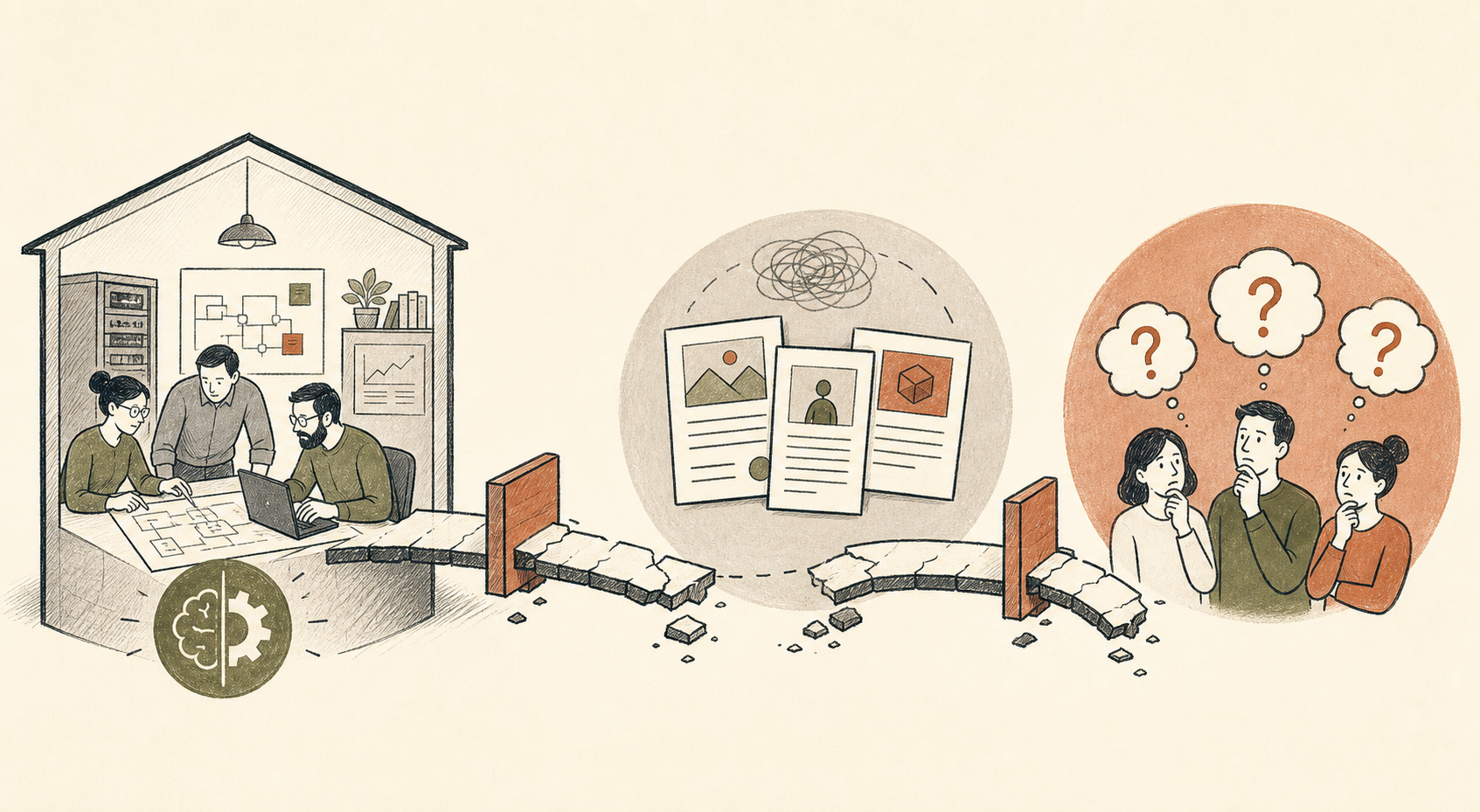
The content visibility gap: valuable expertise exists, but buyers cannot easily find, understand, or act on it.
Meanwhile, potential buyers search for the same problems your team already understands.
They find competitor articles, generic summaries, forum discussions, or AI-generated answers instead.
Your company has the expertise. Someone else receives the traffic.
Valuable knowledge remains trapped inside the company
Search engines and AI platforms cannot use knowledge that remains inside:
- internal documentation;
- support tickets;
- sales conversations;
- technical reports;
- project notes;
- product specifications;
- or specialist knowledge.
Search systems need accessible pages they can crawl, interpret, and connect to real user questions.
Google's SEO Starter Guide recommends clear titles, useful structure, descriptive text, relevant links, and accessible pages.
These requirements help search systems understand a page. They cannot compensate for an answer that is vague, incomplete, or disconnected from what buyers need.
Existing content often targets topics, not problems
Many technical companies publish content regularly but still generate little qualified traffic.
The articles may cover broad industry topics, company news, product announcements, or high-volume keywords.
They rarely answer the detailed questions buyers ask before making a decision.
A useful technical page needs to connect:
- a real buyer problem;
- the language used to search for it;
- evidence from people who understand the subject;
- a clear and understandable explanation;
- and a relevant next step.
When these elements are missing, publishing more content only creates more pages with limited business value.
Generic writing removes the strongest evidence
Technical expertise becomes valuable when it includes details.
Buyers need to understand:
- what was tested;
- what conditions affected the result;
- which trade-offs were considered;
- where an approach works;
- where it fails;
- and what should happen next.
Companies often remove these details to make content sound simple or safe.
The result is polished copy that could have been written by any competitor.
Google's guidance on helpful, reliable, people-first content encourages original information, first-hand expertise, clear authorship, and content that helps readers complete a goal.
Technical content should not hide expertise. It should make that expertise understandable.
Search visibility is only part of the problem
Ranking on Google does not guarantee that a page will generate useful traffic.
A page can attract visitors who are:
- searching for the wrong information;
- too early in the buying process;
- outside the target market;
- or unable to connect the answer to a service.
Traffic becomes valuable when the content attracts people with a relevant problem and helps them move toward a decision.
This requires more than keyword placement.
It requires content optimization across:
- search intent;
- technical accuracy;
- structure;
- internal linking;
- evidence;
- positioning;
- and conversion paths.
AI answers expose the same weaknesses
AI platforms do not remove the need for useful, accessible, and credible content.
Google's guidance for AI features in Search states that established SEO practices still apply.
The original GEO study explored methods for improving visibility within generated answers. It did not show that a specific writing format guarantees lasting visibility, traffic, or revenue.
The underlying problem remains the same.
If your website does not contain a clear, evidence-based answer, search engines and AI systems have little reason to surface or cite it.
The real content problem
The problem is not always a lack of expertise.
It is often a failure to:
- identify the knowledge buyers need;
- extract it from internal sources;
- connect it to real search behaviour;
- structure it into useful content;
- improve its search and AI visibility;
- and guide readers toward a relevant next step.
Until that process is fixed, publishing more articles will not consistently generate qualified traffic.
A useful first audit
Start with ten questions heard repeatedly in sales, support, implementation, or product discussions.
For each question, ask:
- Do we have a public page that answers it?
- Does the page use the language buyers search with?
- Does it include first-hand technical evidence?
- Can a new reader understand the answer?
- Does it lead to a useful next step?
- Can search engines and AI systems access the page?
The missing, weak, or disconnected answers reveal the real content backlog.
Next, see how to build a connected SEO and AEO content strategy, then learn how to measure content against business results.