
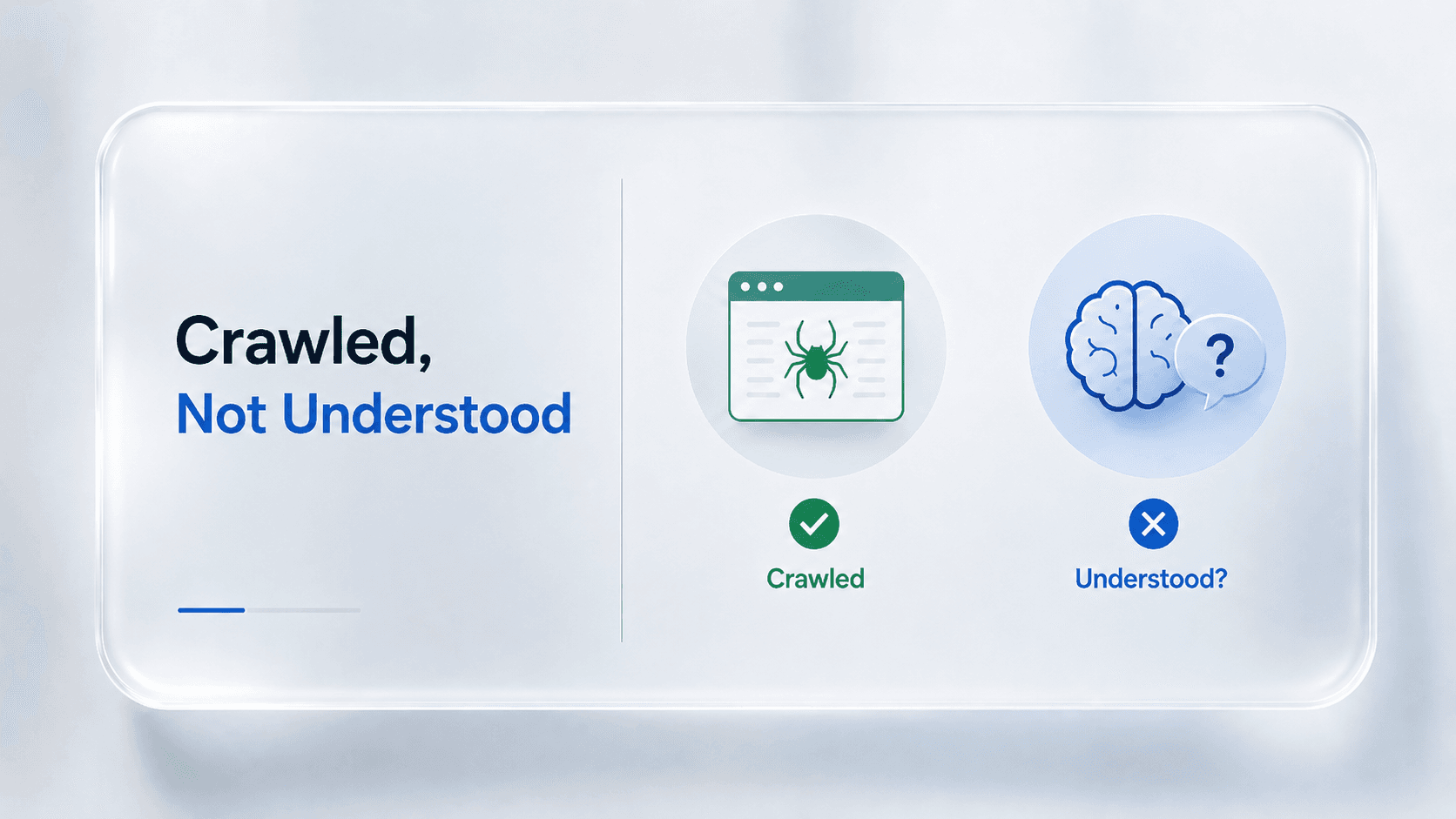
AI Can Crawl the Website. Can It Understand the Content?
Reaching a public URL does not prove that a crawler found the answer on the page.
A product manager approves a detailed comparison page. Buyers can see specifications, prices, and limitations after the interface loads. Yet the initial HTML contains empty containers. Search and content teams bear the cost when retrieval systems receive the URL but miss the facts. The key decision is not whether to permit crawling. It is whether the delivered page preserves the answer.
AI crawlers can fetch pages and extract accessible text, metadata, and structural signals. They may still miss content that depends on JavaScript, interaction, or visual layout. Crawl access is not comprehension.
Here, “understanding” means extracting enough information for classification, retrieval, or citation. It does not mean understanding the page as a person would.
A crawler visit starts a pipeline, not a conclusion
The relevant workflow is:
Fetch → render → parse → extract → interpret
Fetching retrieves the server response. Rendering runs code that adds content, if the crawler supports it. Parsing identifies headings, links, metadata, and page elements. Extraction converts useful material into text or structured fields. A later system may interpret that output to classify the page or answer a query.
Cloudflare describes web crawlers as programs that discover pages, follow links, and collect content. Those mechanics establish access. They do not prove that the final extraction preserved the page’s meaning.
AI-related crawlers also serve different purposes. OpenAI documents separate bots for search, model training, and user-initiated page access. One bot reaching a page does not establish access for every other system.
Initial HTML determines what some crawlers can extract
Consider this illustrative example:
<div id="specifications"></div>
<script>loadProductSpecifications()</script>
A browser runs the script and inserts the specifications. A crawler that processes only the original response finds an empty container.
Now compare it with server-rendered HTML:
<section>
  <h2>Operating temperature</h2>
  <p>This sensor supports temperatures from -20°C to 80°C.</p>
</section>
The second response contains the answer without requiring JavaScript. Its markup also preserves the relationship between the specification and its value.
This matters because rendering support varies. Vercel reported that the major AI crawlers observed in its network analysis did not reliably render client-side JavaScript. That finding does not describe every crawler or every future implementation. It does show why JavaScript-only delivery creates avoidable risk for essential content.
Structure reinforces meaning but cannot recreate missing facts
Clear headings, descriptive links, metadata, and structured data help machines identify entities and relationships. They work best when the underlying facts already appear in accessible text.
Schema markup cannot reconstruct a qualification that is absent from both the initial HTML and the crawler’s rendered output. Nor does schema guarantee indexing or citation. The practical design rule is simple: place the essential answer in readable HTML, then use metadata and schema to reinforce it.
Test the extracted answer, not the HTTP status
This guidance synthesizes public technical evidence. It is not a JaksLab crawler benchmark or proof of citation performance.
Evaluate each important page template with four checks:
- Can the intended bot access the URL?
- Does the initial HTML contain the essential answer?
- Does extracted text preserve headings, values, and qualifications?
- Do visible content, metadata, and structured data agree?
Start with one high-value page. Compare its raw HTML, rendered page, and extracted text. If a price, limitation, or specification disappears, flag the template for engineering review. The content owner should verify the corrected output and remain accountable for the published claim.
A successful request proves that the server answered. Only the extracted output shows whether the page delivered enough evidence to represent the content accurately.