
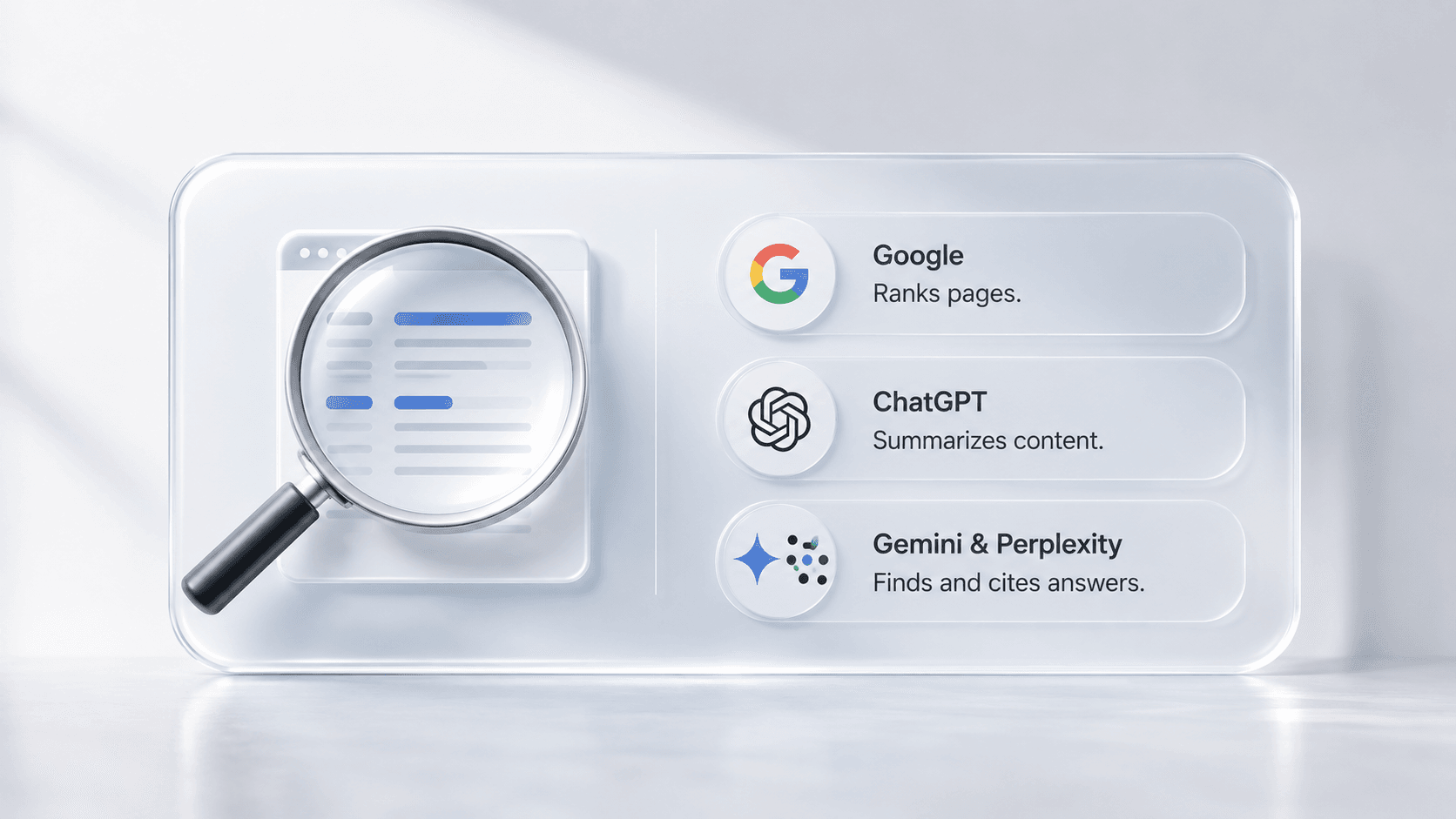
Your Blog Targets Google. What About ChatGPT, Gemini and Perplexity?
Keep SEO as the foundation, then make valuable articles easier to retrieve, interpret and verify.
A content lead reviews a blog that earns Google impressions and qualified visits. Then a founder asks whether ChatGPT, Gemini or Perplexity can use it. Rewriting the entire blog would consume time and could damage pages that already work. The safer decision is to extend the current SEO approach through clearer answers, stronger evidence and focused testing.
SEO remains necessary. It does not guarantee visibility in AI answer systems. A useful shared baseline is accessible HTML, question-led sections, direct answers, traceable sources and explicit limits.
Google SEO remains the technical foundation
Google discovers pages through crawling, indexing and result serving, as described in How Google Search works. If the crawler cannot access the main text, better writing will not rescue the page.
Google also says its AI search experiences use existing search requirements. Site owners do not need special AI files or markup to qualify, according to Google’s guidance for AI features. This is Google-specific guidance. It does not explain citation selection in other products.
Build passages that answer real questions
For editorial planning, retrievability means that a system can locate a relevant passage and use it when forming an answer. Treat this as a design goal, not a ranking factor.
A practical content flow looks like this:
User question → accessible page → relevant passage → supported answer → human verification
Consider an illustrative article about API rate limits. A weak opening spends four paragraphs defining APIs. A stronger version answers the operational question first:
An API rate limit controls how many requests a client can send within a set period. When the limit is reached, the server rejects or delays further requests.
Later sections can explain windows, status codes, retries and exceptions. The editor checks the technical details and approves the final claim. This structure helps the reader immediately and gives retrieval systems a focused passage to process.
JaksLab’s public content workflow follows the same editorial discipline. Articles start from documentation, interviews, support questions and approved sources. Subject specialists review the substance before publication.
Three products do not form one channel
ChatGPT, Gemini and Perplexity are separate products. Their access, retrieval and citation behaviour can vary. Available public evidence does not establish one optimization recipe for all three.
Structured data does not remove that uncertainty. Google says structured data can help Search understand page content in its technical introduction. It may improve interpretation within supported Google features. It does not guarantee a citation elsewhere.
The common failure is clear: a team adds FAQ markup and compressed answers but leaves the article generic. Machine-readable content can still lack evidence, boundaries and technical depth.
Test one page before changing the blog
Choose one article that answers a commercially important question. Record its current search impressions, qualified visits and enquiries. Then check five design rules:
- The main text loads without authentication or broken rendering.
- The core question receives a direct answer within three paragraphs.
- Each heading represents a real supporting question.
- Consequential claims link to traceable sources.
- A human reviewer checks examples, limits and technical accuracy.
Next, run a small pilot with representative prompts across the three products. Record mentions, citations, wording and referral visits. These are operational proxies, not proof of complete AI visibility. Prompt results can also change over time.
Optimize for use, then measure discovery
Do not replace proven SEO work with an unverified formatting playbook. Improve one valuable page, preserve its baseline and test whether the revision makes its answers clearer and easier to verify.
The final standard is not whether an article looks optimized for AI. It is whether a person can find the answer, inspect the evidence and make a sound decision. Search engines and answer systems may reward that work differently. The article still has to deserve use.