
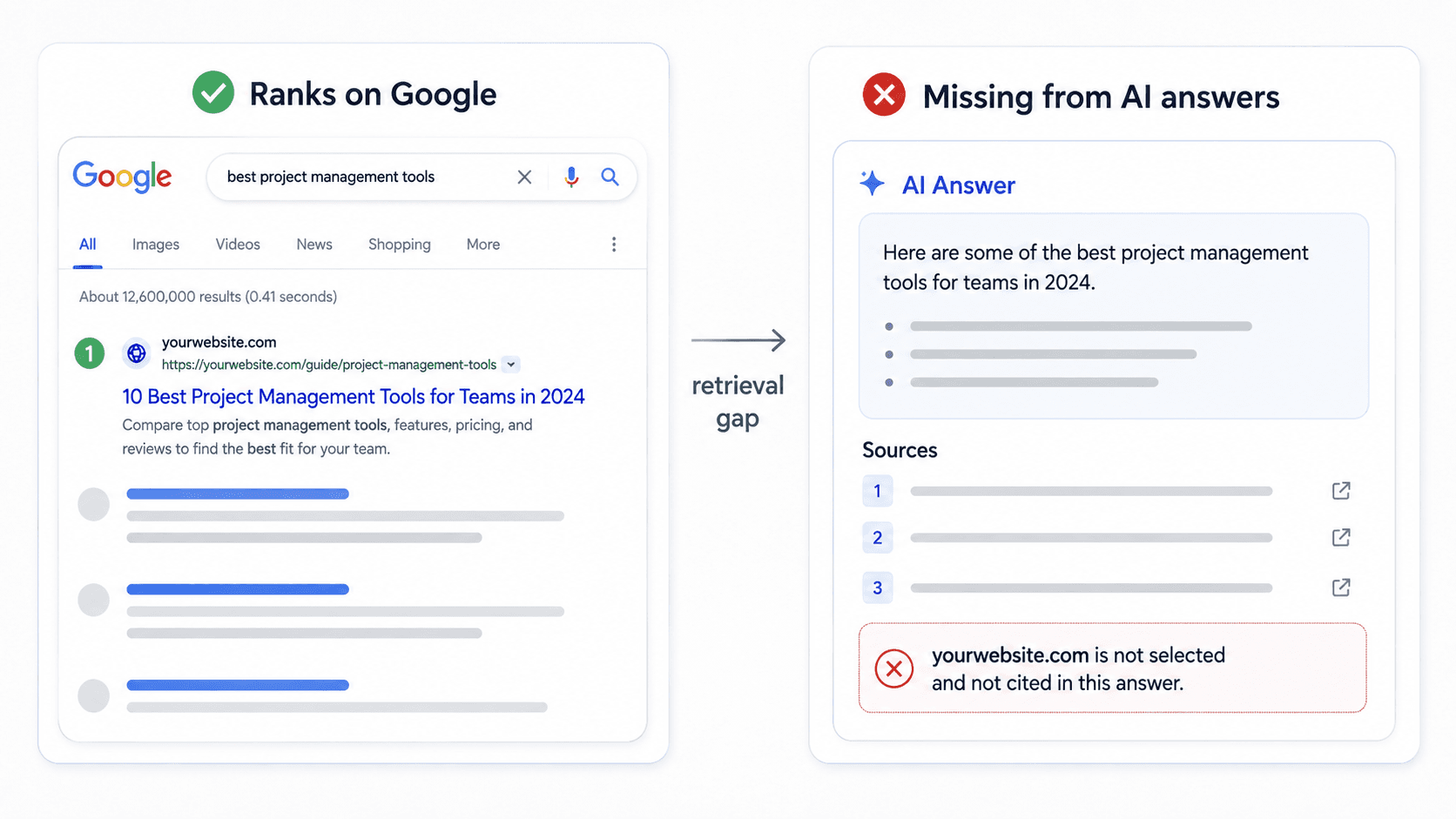
The Website Ranks on Google. Why Is It Missing From AI Answers?
Based on current practitioner evidence, Google ranking confirms search visibility, but AI inclusion may also depend on access, extractability, prompt alignment, and citation readiness.
A product marketing lead sees the company page near the top of Google. Then a buyer asks an AI assistant a similar question, and only competitors appear. Rewriting the page could waste time if the real problem is technical access or mismatched intent. A four-stage audit helps identify what to investigate first.
Google ranking does not guarantee inclusion in AI answers. Google uses multiple ranking systems to identify useful search results. Current research and practitioner evidence suggest that other systems may retrieve, evaluate, and present sources differently. A high position remains useful evidence of relevance to a Google query, not proof of selection for a particular prompt.
Check access before changing content
Start with the exact URL. Indexing means a search engine has stored the page for possible retrieval. Crawlability means an automated system can reach its content.
Check Google Search Console, the selected canonical URL, robots directives, and the rendered page. Google’s missing-page guidance recommends confirming index presence before requesting another crawl.
A ranking usually indicates that the page is indexed and accessible for that query in Google Search. Other systems may still encounter blocked crawlers, conditional access, or content available only after client-side scripts run. Compare the initial HTML response with the rendered page. If the main answer is absent from the HTML, investigate access and rendering before editing the copy.
Test whether a passage stands alone
Extractability means a passage keeps its meaning when removed from the surrounding page.
Consider this hypothetical sentence from an invented cloud backup page:
Evaluate recovery time, retention requirements, encryption, and restore testing before comparing storage prices.
The advice is useful, but its purpose may be unclear without the heading. A section titled “How to evaluate cloud backup software,” followed by a direct answer, supplies stronger context.
Clear headings and answer-first passages are commonly recommended because they may make retrieval and quotation easier. Treat this as a testable content change, not a proven citation factor or guaranteed route into AI answers.
Compare the keyword with the prompt
“Cloud backup software” suggests a product category. “How should a hospital evaluate cloud backup?” asks for criteria, risks, and sector constraints. A page can satisfy the first query while missing the second task.
Create a fixed set of buyer prompts. For each test, record the platform, date, answer, cited URLs, and quoted passages. Compare each prompt’s intent with the task answered by the cited passages. Then assess whether your page offers an equally direct response.
If the page answers another task, revise it or create content for the missing task. If it already provides a direct answer, investigate source selection, trust, and entity clarity as diagnostic hypotheses rather than confirmed platform rules.
Review visible evidence
For this audit, visible evidence means named authors or responsible organizations, dates where freshness matters, links supporting factual claims, and consistent product and company terminology. This is a practical editorial checklist, not a proven visibility rule.
A content owner should verify important claims, while an editor tests whether key passages stand alone. Structured data may help interpretation, but current evidence does not show that it directly causes inclusion in AI answers.
Google’s people-first content guidance emphasizes reliable, useful, well-sourced material rather than mechanical search tactics.
Record the diagnosis
Use the audit to separate possible failure modes:
| Test | Evidence to record | Next decision |
|---|---|---|
| Access | Index status, HTML, rendered text | Fix access or continue |
| Extraction | Standalone 40 to 80-word answer | Restructure or continue |
| Alignment | Prompt task versus page task | Revise, add a page, or continue |
| Credibility | Author, sources, dates, entity terms | Address specific evidence gaps |
AI outputs can change, so repeat the same prompt set over time. Do not treat an absent citation as proof of weak content. Treat it as an unresolved retrieval result.
Check access first, followed by extraction, intent, and visible evidence. Google rank shows where the page already succeeds. The audit identifies what to test next.