
llms.txt Is Not the AI Search Strategy. Is Your Website Ready?
The proposed file is easy to publish, but useful AI visibility still starts with accessible pages and clear answers.
A content lead wants more visibility in AI answers. Publishing /llms.txt takes one small ticket. Fixing hidden content, weak headings, unsupported claims, and broken internal links takes longer. The choice is whether to rely on the shortcut or first improve the pages an answer system is most likely to use.
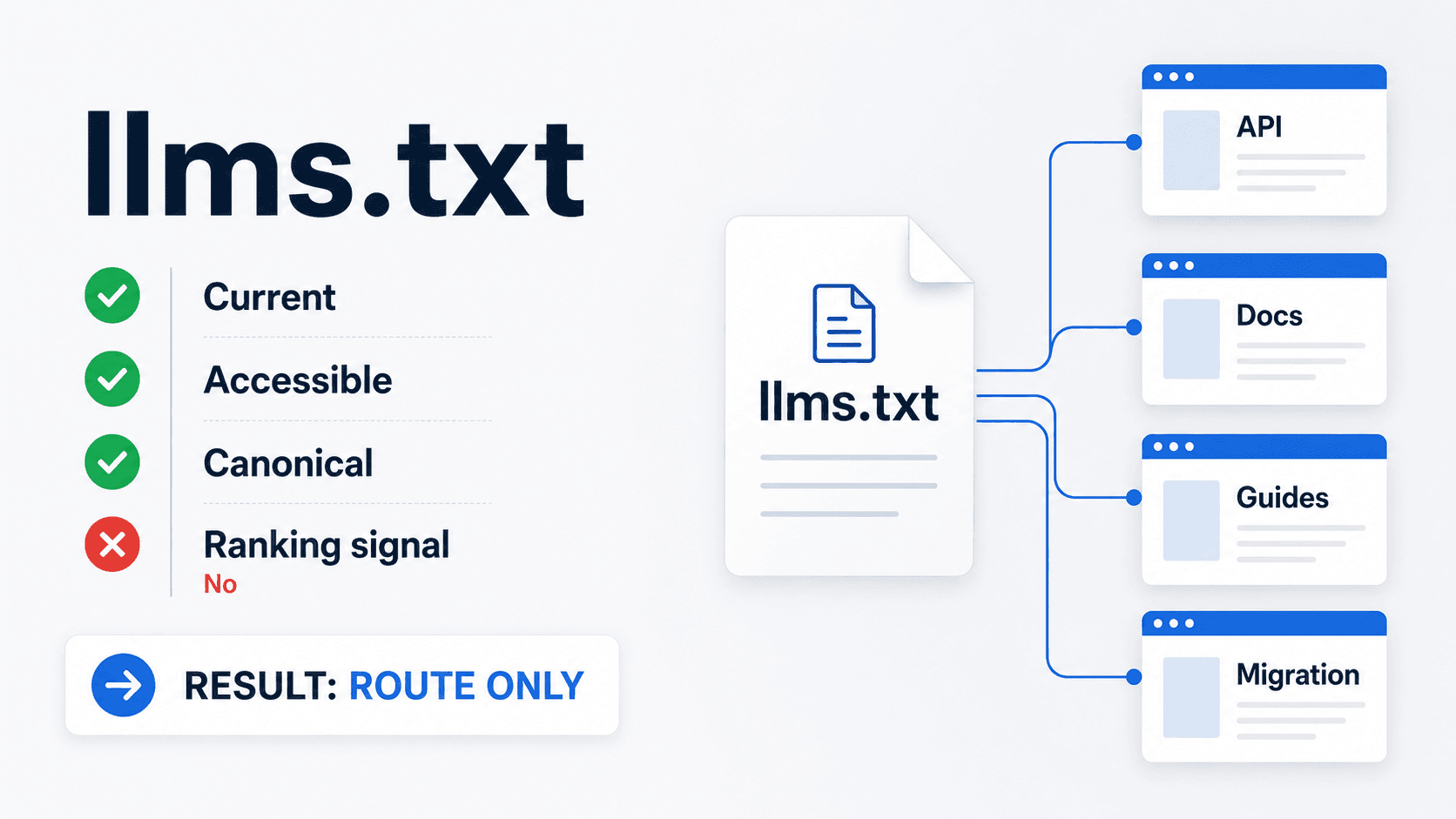
The direct answer is that llms.txt is not sufficient evidence of AI-search readiness. It is not a validated ranking or citation signal today. Google’s guidance for AI features says special machine-readable files such as llms.txt are not required for Google’s generative search features. That guidance is specific to Google and does not establish a universal rule for other AI platforms.
llms.txt proposes a map, not a validated signal
The llms.txt proposal defines a Markdown file at /llms.txt. In the proposal, the file is meant to give large language models a concise, curated view of a website during inference, when a model forms an answer.
The proposal positions the file as a site summary, not as a replacement for familiar crawl-control or URL-discovery mechanisms. It also does not prove that major answer systems fetch the file or reward websites that publish it.
Because llms.txt remains a proposal, its suggested format should not be mistaken for a platform-wide implementation standard. Some teams may still consider it a lightweight convenience layer, especially when it can be generated and maintained without diverting resources from more important work.
Readiness depends on the destination pages
The evidence here suggests that practical readiness depends more on accessible, structured, authoritative pages than on adding llms.txt alone. A useful audit model is:
Accessible page → parsed content → relevant passage → generated answer → possible citation
Each step can fail. Important text may appear only after a client-side interaction. A heading may use an internal product name rather than the buyer’s language. A commercial or technical claim may lack enough context to be assessed or quoted confidently.
Check four conditions:
- Access: Important pages return useful HTML and are not unintentionally blocked.
- Clarity: Each page answers a defined customer question directly.
- Structure: Headings, lists, tables, links, and structured data match the visible content.
- Traceability: Specialists can verify important technical and commercial claims.
These conditions do not guarantee an appearance or citation. They improve the material available for retrieval and human review.
A clean file cannot repair an unclear page
Consider an illustrative software-company scenario. Ten product pages hide system requirements inside interactive tabs. Their headings use internal product names, while performance claims appear without supporting context.
Adding those pages to llms.txt creates a cleaner directory, but it does not rewrite the destination content. The pages still have weak passage boundaries and claims that are difficult to assess.
A better first sprint would expose requirements in rendered HTML, define each product plainly, add headings based on buyer questions, connect relevant implementation pages, and send technical claims to a specialist for approval.
Run a retrieval pilot before adding another file
Start with five real buyer questions. Use the following as an illustrative internal check, not a standardized benchmark:
- Identify the page that should answer each question.
- Inspect the rendered HTML and confirm the relevant text is accessible.
- Check whether the answer appears in one self-contained passage.
- Run consistent prompt-based checks across selected AI tools.
- Record observable answer appearances and citations before and after editing.
Keep the questions, prompts, tools, and observation dates consistent. The results can expose retrieval problems, but they cannot prove that one edit caused an answer or citation. Platforms and generated responses change.
Add llms.txt when it is inexpensive to generate, easy to maintain, and secondary to page improvements. If destination pages cannot answer important questions cleanly, repair them first. The optional map should not consume the sprint needed to make the underlying content usable.