
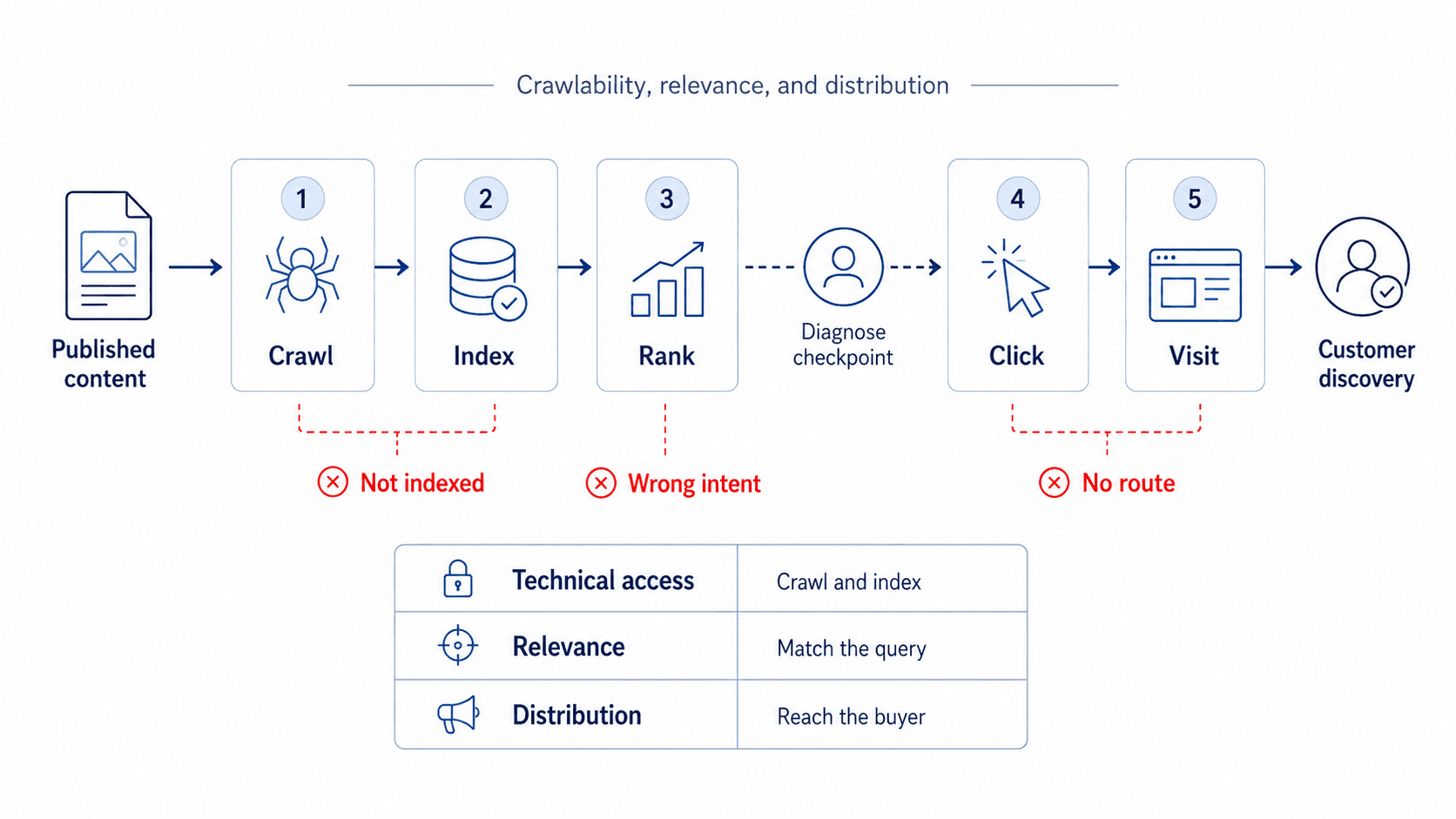
Published but Invisible: A Five-Gate Content Audit
Useful content stays hidden when the path between publication and customer discovery breaks.
A content lead reviews the company blog. The technical guides are accurate. Product experts approved them. Yet qualified visits remain flat, and readers rarely reach a product or service page. The next budget request calls for more articles, but the team first needs to find where discovery is failing.
Good writing is necessary, but it does not guarantee visibility. A page may be excluded from a search index, buried in the site, aimed at the wrong query, unable to compete, or absent from the channels buyers use. Diagnose that path before commissioning more content.
Publication means the page exists. Indexing means a search engine has stored it for possible retrieval. Ranking determines where it appears for a query. Distribution places it in newsletters, communities, sales workflows, and other audience channels. Conversion happens only after the right person arrives and acts.
Indexing is the first gate, not the whole diagnosis
Use this five-gate workflow in order. Each gate tests a different failure.
-
Confirm indexability. Inspect the page in Google Search Console. Check its index status,
noindexdirectives, robots.txt rules, canonical selection, and discovery path. Google’s missing-page guidance identifies these as core diagnostic checks. Rewriting an excluded page will not remove the exclusion. -
Trace internal reach. Start from the home page, a service page, or a relevant topic hub. Can a customer reach the article through useful links, or does the route end in an archive? Link the article where it answers the next question in the journey. Internal links help discovery, but they cannot repair weak intent or authority.
-
Test intent fit. Compare the page with the task behind the query. A buyer searching for “identity provider integration architecture” needs technical design guidance. A buyer searching for “identity provider integration pricing” is evaluating a purchase. A page that mixes both tasks may satisfy neither. Content focused on company messaging rather than buyer needs can lose relevance, as the Content Marketing Institute explains.
-
Assess the competition. Review the pages already visible for the target query. They may provide stronger evidence, deeper coverage, clearer subject authority, or a format better suited to the search. Search Engine Land’s practitioner analysis identifies technical barriers, authority gaps, and misaligned competition as possible causes of poor visibility.
-
Check distribution. Determine whether the intended audience relies on search at all. The article may belong in onboarding, a sales follow-up, a customer newsletter, or a specialist community. Publishing to a resource centre does not ensure buyer reach, a problem also raised in Content Camel’s distribution analysis.
One broken route can hide an accurate guide
Illustrative example: A software company publishes a correct identity-provider integration guide. Google has indexed it, but no integration page links to it. Its title uses an internal project name that customers do not search.
The evidence points to internal reach and intent, not writing volume. Rename the guide around the customer task, link it from the integration journey, and distribute it through relevant support and sales workflows. A second isolated guide would repeat the same error.
Measure the break you tried to repair
Match each gate to a signal. Index coverage tests technical access. Relevant impressions test query alignment. Clicks from connected pages test internal reach. Search position under comparable queries provides competition context. Newsletter or sales-assisted visits test distribution. Movement into product pages shows whether discovery reaches a useful next step.
The available evidence supports this diagnostic model, but it does not provide a universal benchmark or prove which gate fails most often. A content owner must interpret intent and quality, a technical owner must verify index controls, and a commercial owner must define the downstream action.
JaksLab’s published content workflow follows the same review-first principle: examine existing work, update weak pages, remove repetition, and connect useful articles to relevant services. That is a service method, not a measured performance claim.
Start with one high-value page that customers should find. Test all five gates before adding another article. Content inventory measures what you published. Discovery measures whether the right person can reach it.