
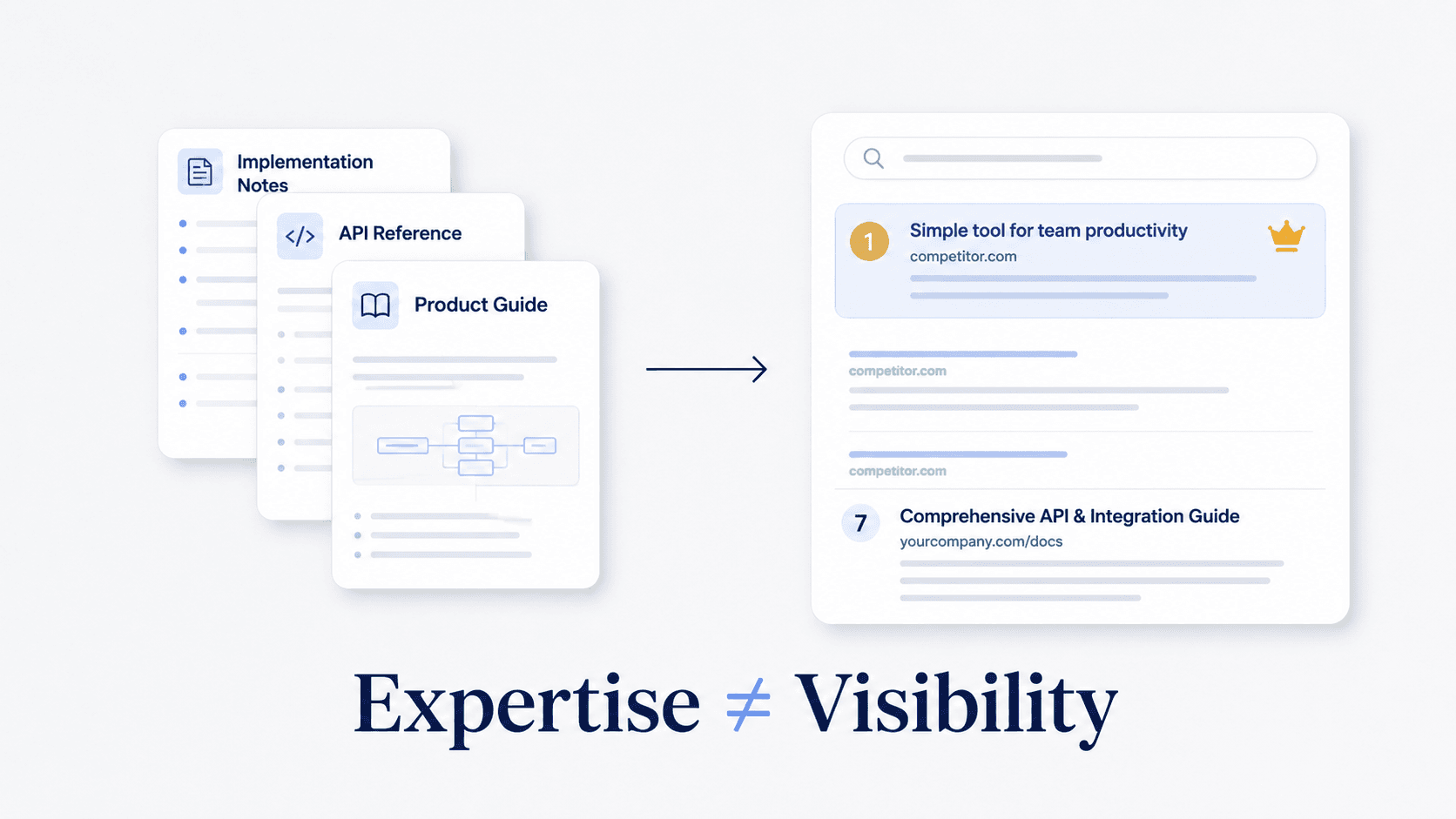
When Expertise Is Invisible: Why Competitors Own the Search Results
Search visibility does not prove who knows the most. It shows which pages a search system selected for a query.
Your engineering lead searches a common customer question. A competitor’s basic guide appears first. Your detailed service page is absent, so sales keeps explaining the same issue by hand.
The next step may not be commissioning more content. It may be determining whether the existing page has the wrong job, structure, or technical path.
This article presents a diagnostic framework for common informational and commercial query classes, not a universal rule for why pages rank.
Google says its ranking systems use many factors and signals to return relevant, useful results in its Guide to Search Ranking Systems. Expertise can contribute to a strong page, but subject knowledge alone does not guarantee visibility.
The page must perform the job behind the query
Search intent is the task a person wants to complete. Someone searching “how to monitor remote equipment” probably needs an explanation or implementation guide. A product page that immediately asks the visitor to book a demonstration serves a different task.
Format fit describes whether the page type matches that task. Current results can provide a practical indication of what search systems consider useful for a particular query. If most leading pages are guides with diagrams and implementation steps, a short sales page may face a structural mismatch.
Technical eligibility also matters. Google Search Essentials recommends crawlable links, helpful people-first content, prominent use of relevant terms, and structured data that follows its guidelines. These practices can help Google find and understand a page, but none guarantees a ranking.
A deeper answer can still take the wrong form
Consider a hypothetical industrial monitoring company with a service page covering protocols, architecture, security, and deployment options. It targets the query “how to monitor remote equipment.”
A competitor publishes a guide defining the process, diagramming the data flow, listing setup steps, and explaining common failures. The guide may contain less engineering detail, but it answers the immediate question more directly.
The operational difference is simple:
- The searcher asks how monitoring works.
- The service page explains what the company sells.
- The guide explains what the searcher should do.
Adding another thousand words to the service page may preserve the mismatch. A more useful editorial decision could be to publish a separate implementation guide, then connect it to the relevant service page.
Diagnose the failure before commissioning content
The following process is an editorial synthesis of published guidance, not a ranking experiment:
Query → current results → page comparison → technical check → failure diagnosis → human decision
Evaluate four conditions:
- Intent: Identify the task repeated across the leading results.
- Format: Record whether guides, comparisons, tools, or commercial pages dominate.
- Eligibility: Check crawlability, indexability, internal links, headings, and canonical settings.
- Trust: Verify authorship, technical claims, sources, and specialist review.
The output should identify a likely failure rather than promise a ranking. Reformat a page when its job appears wrong. Repair discovery paths when crawlers cannot reach it. Add evidence when important claims are difficult to verify. Expand the content when the comparison reveals a genuine information gap.
A content lead should interpret the results page. A developer should verify technical eligibility. A subject specialist should remain accountable for accuracy.
Visibility is not proof of competence
A ranking cannot demonstrate that a competitor knows more or less. Brand familiarity, links, topical coverage, distribution, page quality, and other signals may also explain the result.
Start with one customer query. Capture the ten leading results, classify their page types, and compare their opening answers with yours. This creates a concrete diagnosis before another content batch is approved.
Search visibility can improve when genuine expertise is converted into the page type a query appears to require, then made accessible and understandable to both the search system and the reader.