
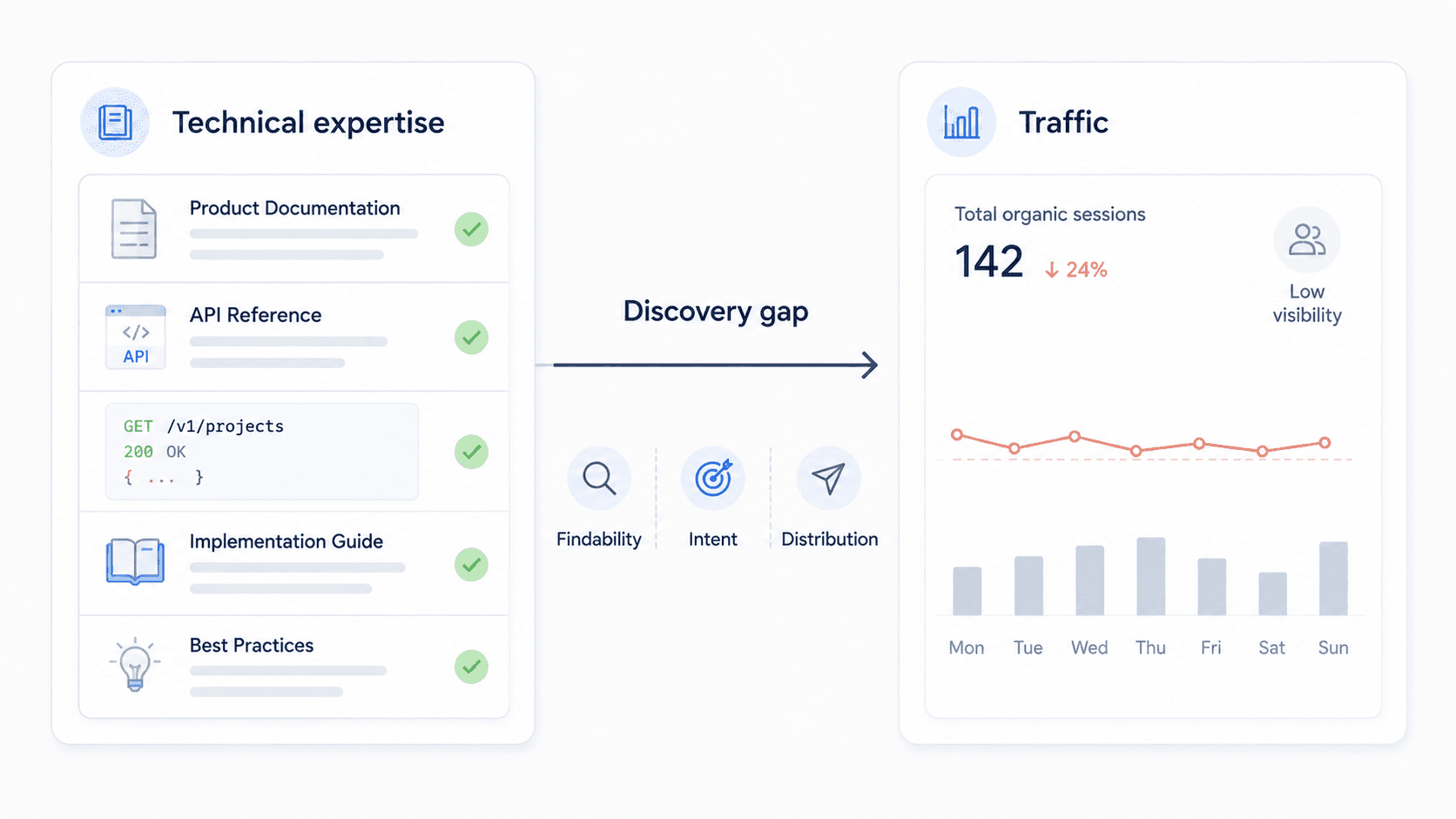
Deep Technical Expertise Exists. Why Isn’t It Driving Traffic?
Technical knowledge drives qualified traffic only when buyers and search systems can find, understand, and use it.
A product marketing lead checks the analytics dashboard after another release. The engineering team has published detailed architecture notes, but qualified search visits remain scarce. Engineers keep writing while buyers still struggle to find answers to the problems they bring to sales.
Expertise does not create visibility by itself. It must become accessible, intent-matched content with descriptive titles, useful structure, and relevant internal links. The Google Search Central SEO Starter Guide identifies these as fundamentals that help readers and search engines understand a site’s pages.
JaksLab describes its own approach as turning technical knowledge into “clear answers people can find and trust.” Its services page explains how documentation, reports, internal pages, and specialist knowledge can become customer-facing articles, while its About page emphasizes working from approved sources and keeping specialists involved. These are workflow principles, not evidence of guaranteed traffic gains.
Diagnose the content system before the expertise
A content system includes the pages, links, topics, and publishing decisions surrounding a company’s knowledge. It can become a bottleneck when useful material remains inside documentation, relies on internal terminology, overlaps with existing pages, or lacks a clear reader task.
This distinction separates two possible problems. A knowledge problem requires stronger expertise or evidence. A content-system problem calls for better translation, structure, consolidation, or distribution. Publishing another article may not help if it duplicates an existing page or provides no route from a buyer’s question to the answer.
One accurate article can still miss the buyer
Illustrative example: A payments platform publishes “Architecture of Our Event Processing Layer.” It explains queues, retry policies, and idempotency, which allows an operation to repeat without causing another change after its first success.
A technical buyer searches for “how to prevent duplicate payment events.” The article contains the answer, but its title describes an internal component. Its opening assumes platform knowledge, and no integration page links to it.
The page could answer the duplicate-event question first, explain the mechanism and its limits, and then connect readers to relevant integration guidance. The intended result is a clearer route from the buyer’s query to the existing technical answer without removing the engineering detail.
Audit the route before producing more
This audit is a recommendation, not a promise of rankings or leads. It draws specifically on Google Search Central’s fundamentals, JaksLab’s documented content workflow, and Jake Ward’s linked practitioner checklist for reviewing existing pages.
- Inventory the source material. Record public pages, documentation, reports, support questions, and expert notes.
- Assign one reader task. Decide whether each page helps someone learn, compare, troubleshoot, evaluate, or buy.
- Check the search route. Confirm that search engines can access the page and that relevant pages link to it.
- Resolve overlap. Keep distinct pages, merge competing ones, update useful material, and remove unnecessary repetition.
- Publish the gap. Create a page only when existing material cannot answer an important buyer question.
Specialists should review technical substance while a content owner manages page purpose, consolidation, internal linking, and publication decisions.
Evaluate the entire route
Use three diagnostic gates:
- Discovery: Is the page indexed and receiving impressions for relevant queries?
- Intent: Do those queries match the problem, audience, and format the page serves?
- Business route: Can readers continue to useful product, service, integration, or implementation information?
Recommended measures include impressions, qualified clicks, onward paths, and relevant enquiries. Examine whether readers continue from a troubleshooting article to integration documentation, a comparison page, or a demo request. Raw traffic alone does not show whether suitable buyers are progressing.
Content may not be the main cause of weak traffic. Limited demand, indexing failures, weak authority, poor distribution, intense competition, or weak product-market fit can produce similar symptoms. Diagnose those possibilities before treating publishing volume as the answer.
Start with ten pages tied to one commercial topic. Give each page one reader task and one action: keep, merge, update, remove, or replace. Organize retained expertise around buyer questions, preserve specialist review, and provide a concrete next step such as integration documentation, a comparison page, or a demo request.